In our blog, we will be using whole grains to create a variety of delicious and nutritious recipes.
But before we dive into the recipes, let’s first understand what a whole grain actually is and how it looks.
To make it easier, let’s take a whole wheat grain as an example and explore its structure.

Grain’s Structure
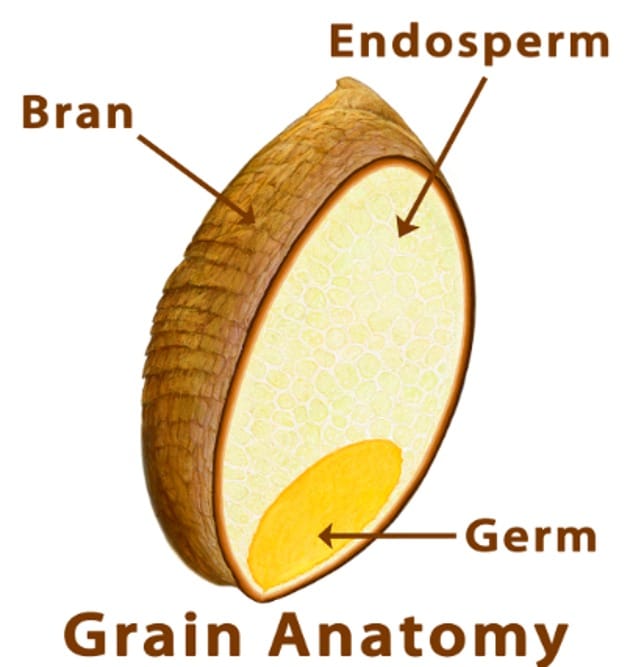
A wheat grain (kernel) has three main parts:
a) Bran (Outer Layer)
- Multi-layered outer coat
- Rich in fiber, B vitamins, minerals, antioxidants
- Protects the grain
- Removed in refined flour
b) Germ (Embryo)
- The reproductive part of the grain-this is the living part of the grain too.
- Contains vitamin E, healthy fats, B vitamins, proteins, enzymes
- Small but nutrient-dense
- Removed in white flour
c) Endosperm (Starchy Core)
- Largest part of the grain (~83% of weight)
- Mainly starch and protein (gluten)
- Provides energy and structure in bread
- Present in all types of flour
d) Optional: Husk
- Inedible outer covering (removed before milling)
We use Living Grains not dead grains!
When we talk about grinding or milling grains, we mean milling living grains, not dead ones.
Living grains are capable of sprouting under suitable conditions and can grow into a new plant.
Dead grains, on the other hand, do not sprout at all, no matter how ideal the conditions are.
As their name suggests, they are dead.
When I began my journey into fresh milling of whole grains, I used some wheat grains without checking whether they were still living.
The result was shocking.
In my family, B has severe allergies to certain foods.
After I milled those grains and made fresh tortillas, B developed a severe allergic reaction, while S developed eczema rashes.
To make sure it wasn’t a coincidence, I repeated the experiment the next day. B’s allergic rhinitis became even worse, and S’s eczema rashes increased.
I then began to suspect that the grains themselves were the problem, so I decided to test whether they were still living.
After soaking them for just 8 hours, they gave off a very foul smell, and the grains had almost turned mushy.
It was clear that these were not living grains.
Instead of throwing them into the dustbin, B scattered them on the ground for the birds to eat. Surprisingly, the birds did not touch them. The grains remained exactly as they were.
Where to buy living Whole grains in Qatar?
In Qatar, we have Nature land in al Waab, doha selling organic whole wheat grains – heirloom variety (non-hybrid, ancient wheat grains), rye, barley and many more.
I personally use these grains to make soft, fluffy breads, cinnamon rolls, pizzas, cookies, and other recipes.
We also have the Ansari brand, which sells whole wheat grains. Although they are not organic, they sprout well. You can find them in Carrefour or Lulu supermarkets.
For buying in bulk, it is better to visit their shop in the Industrial Area and purchase directly.
If you are a seller of (living )whole grains (that’s capable of sprouting) in Qatar, please send us a private message so we can add your name to the list above. This will be helpful for many of us.
Freshly Milled Flour
We freshly mill these whole grains and use them immediately in our recipes.
This milled flour is called freshly milled flour (FMF).
Do you know the nutrients FMF contains? It’s just mind-blowing! SubhanAllah.
Imagine our kids eating breads, pita breads, and pizzas while getting their nutrients for the day. Interesting, right? Then read our blog post, “What Is Freshly Milled Flour and Its Nutrients?”
How to Mill Whole Grains?
To get freshly milled flour (FMF) immediately, it is always better to have a grain mill at home or visit your local milling shop near you. To know more about the grains we use, read our blog post, “How to Mill Whole Grains.”
With Love, Dar Al Khubz